


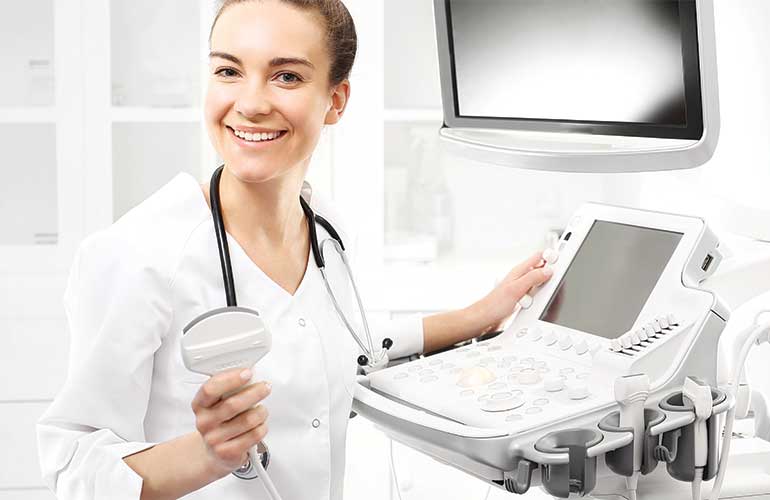
Ultrasound diagnostics (US)
What is diagnostic ultrasound (US)?
During an ultrasound examination, a probe sends a beam of ultrasound waves into the body. At the boundary between two tissues of different density, these waves are reflected back to the probe, where they are picked up by detectors. Computer processing then turns them into an image on the machine's screen.
Ultrasound makes it possible to examine superficial tissues with very high spatial resolution. Ultrasound does not pass through bone, so apart from the bone surface it cannot show other changes in the bone, the bone marrow or structures lying inside the joints.
Unlike other radiological examinations, ultrasound allows a dynamic assessment. Certain pathological changes only appear, or become more pronounced, when a muscle contracts or during particular movements. A further advantage is the possibility of comparing symmetrical structures on the healthy and on the injured or affected side. Doppler ultrasound is very sensitive in showing blood supply in tissues and flow in large vessels. Ultrasound is also extremely useful for guiding puncture needles for diagnostic and therapeutic purposes. No harmful health effects of ultrasound are known.
Do you need to prepare for the examination?
- For an ultrasound examination of the abdominal organs, do not eat for about 6 hours beforehand, as this ensures the best possible visibility. For an examination of the urinary tract, drink 0.5 to 1 litre of water one hour before your appointment.
- No special preparation is needed for an ultrasound examination of the joints and soft tissues or for vascular ultrasound.
- During the examination, you will need to remove clothing from the area being examined.
Preparation instructions for abdominal ultrasound (PDF)
How is the examination performed?
- Depending on the type of examination, you lie or sit on the examination table. The radiologist glides the probe over the part of the body being examined and observes the images on the screen.
- The procedure takes about 15 minutes.
- The examination is painless.
Ultrasound examinations are available on a self-pay basis only.
View the ultrasound price listTypes of examinations
We offer various types of ultrasound examinations. In addition to diagnostic ultrasound examinations, we also perform ultrasound-guided procedures:
- Ultrasound-guided lavage of calcifications
- Ultrasound-guided corticosteroid injection
- Ultrasound-guided drainage of a ganglion cyst
Ultrasound examinations are available on a self-pay basis only.
Read more about ultrasound-guided procedures View the ultrasound price listAppointments
You can book an appointment in several ways. Choose the one that suits you best:
How to book an appointment
- In person – every working day during office hours: between 8:00 and 20:00.
- By post – to the address: MDT&T d.o.o., Lavričeva ulica 1, 2000 Maribor.
- Via our website or by e-mail – to the address: mr@mdt.si.
- By telephone – every working day between 8:00 and 20:00 on: 02 23 53 552 and 02 23 53 553.
You can also book an appointment through the e-booking system on the website of NIJZ (the National Institute of Public Health).
Book an appointmentWaiting time
Check the waiting times for ultrasound diagnostics.
Waiting time in the self-pay clinic as at 3 June 2026 (the date is updated whenever the waiting time changes): 0 – 7 days.
In accordance with the Rules on the longest permissible waiting times for individual healthcare services and on the management of waiting lists, you can check waiting times on the website of NIJZ.
Person responsible for the waiting list
Dr Marko Jevšek, MD, specialist radiologist
Tomaž Friedrich, MD, specialist radiologist
Imaging diagnostics in the Diagnostični center Bled Group
In addition to basic diagnostics, doctors often recommend further imaging (MRI, CT or X-ray).
The Diagnostični center Bled Group is the largest provider of diagnostic imaging in Slovenia — appointments are available with a referral, for self-paying patients and for insurance companies.
Leaflet — MRI, CT and X-ray in the DCB Group (PDF, in Slovenian)